
Scottish Teacher Crisis
Why is no one getting a permanent job?

A lot of people, probably even in Scotland, don’t know about the teaching crisis. I am constantly hearing that there is a teaching crisis everywhere. Teaching retention is awful! They are all leaving! We are crying out for teachers!
Except we are not.
There isn’t a teacher shortage in Scotland (at least not at the primary level). There is a teacher surplus. What we have is a shortage of permanent teaching jobs. Especially for early-career teachers.
I know the job market is awful everywhere and in pretty much every industry. I completely understand that there are so many jobs out there that have it harder. I just want to raise a bit of awareness because it seems no one outside teaching circles in Scotland is talking about this.
How do you become a teacher in Scotland?
First, you need to have a degree. So that’s either an undergraduate degree in Education or a PGDE after your undergraduate degree. You pass all your placements and graduate. Well Done! That was hard! You are now a provisionally registered teacher.
You will now be assigned a school for your probation year. This is a paid position, so this is the first time you will have been paid to teach. For this, you choose five local authorities, and you will be allocated one. Then you are allocated a school. You don’t really have much say in where you go. At that school, you are a teacher. You’ll have less class contact time than your colleagues (but by the end of the year, you’ll have the same), and you may have more training days. You will also be given a ‘Supporter’ at the school who could be another class teacher or a member of management. Their job is, you guessed it, to support you. You’ll have regular meetings with them, and they will do most of your observed lessons. You also have to do something called a probationer enquiry, where you do a bit of research on your class and write about it, then present it. Crucially, you do have to pass your probation year, but assuming you do…
Congratulations! You are now a fully qualified teacher! You’ll be paid more to reflect this, and now the stress of probation is behind you. You can now move on with your teaching career. But this time you aren’t going to be handed a job. You’ll have to apply for one. Just like everyone else.
Every council does it differently, but I think I can safely say every council has the issue. In my council, we went for something called a generic interview. So all the probationers (and everyone on temporary contracts) go for an interview. If you do well, you are successful, you go on a list, and the teaching jobs are offered from that list. Unfortunately, there are not going to be nearly enough jobs for all the successful candidates. A lot will end up on the supply list (which works like a zero-hour contract and is a nightmare). Very few will be offered permanent contracts.
The Teaching Crisis
To put it simply, there is a shortage of permanent teaching positions. This means that a lot are ending up on temporary contracts, year after year, or on the supply list. This has a huge impact on teachers financially, emotionally and psychologically.

I was a primary teacher so I am going to be focusing mainly on the crisis in terms of primary education. The problem is also biggest with primary teachers. (But that’s not to say it’s not an issue in secondary). For the 2024/25 cohort of probationers, only about 11–12% of primary teachers had a permanent job in the first year after probation.

A lot of the articles I have read for this have been talking about the impact a temporary contract has on teachers. And “teachers with permanent positions are so overworked they were having to work on average a "day-and-a-half extra unpaid”. I’d just like to point out that teachers on temporary contracts are in the same position regarding workload, but face the added pressure of no job security. I also think the day and a half is likely a conservative estimate.
The Teacher Induction Scheme
Every probationer teacher has to be given a job; therefore, local authorities must take on a certain number of probationers. But they are also happy to take probationers because they don’t come out of their budget. Probationer teachers are mostly funded by the Scottish government. This incentivises councils to withhold vacancies from fully qualified applicants in order to bid for subsidised probationers. What makes more sense from the local authority perpective. A teacher with no experience who costs very little or a more experienced teacher who costs much more?
I do think it is a good thing to give young teachers a good start and to help prepare them for what is a challenging career. Teachers with all levels of experience need as much support as they can get! It is a wonderful idea… in theory. But I can’t help but feel there is no point giving young teachers the best start to a career if they aren’t going to have one.
The Supply List
I did supply for a little bit and I can attest that it is hard. I actually quite liked it though. Sure, children love to push boundaries with supply teachers… but they love to push boundaries in general. I liked to say I was ‘borrowing’ a class for the day. There is a lot less pressure with supply and a lot less prep. It does take a certain amount of flexibility and improvisation, but I was fine with that!
What I wasn’t fine with was the lack of work. And the way of getting supply work. Every local authority does it differently but this was the system at the time where I live. When a school needed supply they would send out a text to all the supply list. Now this could be as little notice as a 8.45 text needing you in for 9.00. The first supply teacher to phone the school would get the work. Supply teaching works like a zero-hour contract; you only get paid for the work you do. So if you’re not fast, you are last. I was only a supply teacher for three months. But I only worked for one week during that time. There was nowhere near enough work to support myself. It just isn’t a practical option for most people.
Teaching Shortages
Okay okay. I admit there are some teaching shortages, and that is definitely worth talking about. We need more secondary teachers, especially in subjects like maths. It seems that some secondary schools are using the shortage of primary jobs to their advantage and hiring primary teachers. The SSTA reported that 54% of schools are employing primary-qualified teachers. These are predominantly for additional needs roles, but there are also substantial numbers of BGE (Broad General Education S1-S3) roles. I imagine this is to combat the maths teacher shortages. Surprisingly, there are also primary teachers teaching qualification level classes, which, technically, I don’t believe they are trained to do.
There are also fewer teachers in more rural areas like the Highlands and Islands. In good news, the government are providing more money to these communities to hopefully improve recruitment! An additional recurring investment of £1 million will be made to support rural and island communities that face challenges in recruiting teachers.
Moving Abroad
“I didn't just to move to Dubai for the lifestyle, I moved because I needed the job security”
I would say I see a post on Instagram about a girl I went to university with moving to Australia to teach at least once a month. I don’t think I know anyone personally that has moved to Dubai (and I highly doubt anyone is doing that right now) but I have heard it is happening. And you can’t blame them.
I don’t believe for one second that teachers in Australia have an amazing work-life balance. Some will, I am sure. But Australia’s teacher shortages are among the worst in the world. There will be a reason for that. But for Scottish teachers, they will face the same issues in schools. They may as well move to the other side of the world if they can get a stable job. At least it’s sunny.
There are issues with teaching everywhere
There are so many factors that make teaching so difficult right now. Behaviour in school is becoming more challenging to manage. I don’t know a single teacher who hasn’t had a chair thrown at them (table in my case) or who hasn’t had to evacuate a class. Attention spans are also getting shorter, which is leading to more low-level disruption (don’t underestimate low-level disruption, that is what really pushes you over the edge). I am not one to demonise children, I think there is way too much of that in education. Unfortunately, it is just a fact that behaviour in schools is getting worse. There are also far more children with identified additional needs, but instead of increased support, we are seeing ASN specialists being cut to save money. It is soul-crushing knowing you cannot meet the needs of the children in your class.
Workloads are also insane. To put it into perspective, I genuinely feel I have more free time now, and I work a 9-5 with normal annual leave. I do not miss the school holidays. It is not worth it. It is standard to work way above your contracted hours, including weekends and holidays. I was given the advice not to work a Friday night (with the unspoken expectation that I would be working Saturday and Sunday). The whole system only survives due to those working in schools going way beyond their contractual working hours for the sake of the students. Because it’s easy to justify. It’s for the children.
This excerpt from a TES article this culture into words better than I can.
“In another school, I watched one well-respected head of department being held up as an exemplary teacher by the senior leadership, only for her to then openly attribute her success to the fact that she had no social life, partner or children and often finds herself marking on a Saturday night. If these are the standards that teachers are expected to meet, no wonder it is not sustainable for so many of us to stay teaching full-time”
These issues are not unique to the UK. In Australia, workloads are excessive both in the time demanded and the intensity of teaching work in modern, complex classrooms. Furthermore, nine out of 10 Australian teachers are experiencing severe stress, and nearly 70% say their workload is unmanageable. In Canada, nearly 80% of educators report struggling to cope with unpredictable and mounting workloads. This is contributing to poor teacher retention. In the US, the teaching profession is currently experiencing its lowest levels of employment in 50 years. While researching this, I’ve also found studies on teaching staff shortages in England, Canada and Ireland. And it’s not just Western countries. Globally, 44 million additional primary and secondary teachers are needed.
This is a worldwide issue. But not here.
Why are temporary jobs so bad?
The lack of permanent jobs has an impact on the quality of teaching that takes place in schools.
It also means that we have teachers afraid to make a fuss because they want to keep their jobs. Teachers who are treated horribly by their managers are afraid to go to the union because they don’t want to be labelled difficult. Afraid to take sick days because they don’t want to be seen as lazy or letting down the school. Teachers are being sworn at, spat at, furniture thrown at them, working well over their hours, stressed out their minds, no job security and potentially receiving very little support. They are the lucky ones. At least they have a job. They have to put up with it because what choice do they have? They know how replaceable they are.
Would you stay in a job under those circumstances?
I know I didn’t. I have no interest in returning to teaching. But a lot of my friends are teachers and all much better and more hardworking than I ever was. Out of all of them, one has a permanent mainstream (secondary) teaching job. Two are still mainstream teachers but on temporary contracts for the third year (soon to be fourth). They have what is called ‘permanent rights’ because they have been working this long. But there are no permanent jobs, so they still remain on temporary contracts. One has left mainstream but is still teaching on a temporary contract. One is teaching part-time (because that was the only job available) and supplementing her income with tutoring. That’s just a snapshot, but I think you get the point. I’m tired of celebrating temporary contracts with my friends. They are professionals we need in our society, and they are doing a fantastic job despite the circumstances. They deserve some stability.
And while I am no longer teaching, I am currently on a temporary contract (as are many people out there). It’s no fun not knowing if you’re going to get to keep doing the job you love, especially when you’ve got bills to pay. But that is the nature of the industry I’m in now. It shouldn’t be for teaching. They still have all the other issues that come with teaching from around the world. Burnout, poor work-life balance, challenging behaviour, but with no job security on top of that.
Traditionally, job security has been a key element of attracting people to become teachers. It is part of the reason I trained to be a teacher. People to this day say to me that ‘you’re basically guaranteed a job as a teacher’. They don’t understand why I would leave such a secure career path. But it just isn’t true. It isn’t secure anymore.
What is the government saying about this?
Here are some things that Education Secretary Jenny Gilruth said about this in a recent BBC article.
“I wonder to what extent people are opting not to travel to jobs, in ways that they might have previously, because for example we created those posts during the pandemic”
People are moving to Australia, Jenny.
I’m sorry, but the fact that the education secretary actually thinks this just proves that the government have no idea what is going on here. First of all, councils tend to hire internally first before posting jobs for external applicants. With the job shortage, that means your chances of getting a job in another local authority are significantly lowered. Although people are still applying to jobs outside their local authority. Secondly, I think the point she is trying to make is that there are more opportunities in rural communities and up north. That is true. But the reality of that would mean that the majority of teachers either have to relocate or have very long commutes. Which they already are doing! Three teachers I know personally have relocated (in Scotland) away from their family and friends and their whole support network just for a job. This does worry me because lack of support is a major contributor to stress, burnout, and job dissatisfaction, whereas strong social support networks alleviate these issues. I have also heard of people having ridiculous commutes to work, which eat up so much of their time. Time that teachers frankly don’t have with their workload.
“You’re not guaranteed a job on qualification - you have to go out there and look for one, you have to apply to a range of different local authorities.”
Well obviously. No one is saying that teachers deserve special treatment. However, the government spend a lot of money on the probationer scheme to train up new teachers. And a significant percentage of them are not continuing to teach or taking their skills elsewhere. It’s a waste of money. Take me, for example. The Scottish government invested a significant amount of the £32000 in my probation year costs. Now I’m not teaching and have a lot more free time on my hands (which has resulted in me having plenty of free time to moan about them here on Substack). Their investment didn’t pay off.
“We do need to remember that teachers are now much more expensive to employ than they were back in 2021,”
“We do think meeting demands in terms of the teaching unions’ expectations on pay was the right thing to do, but it has cost the government in excess of £800m”
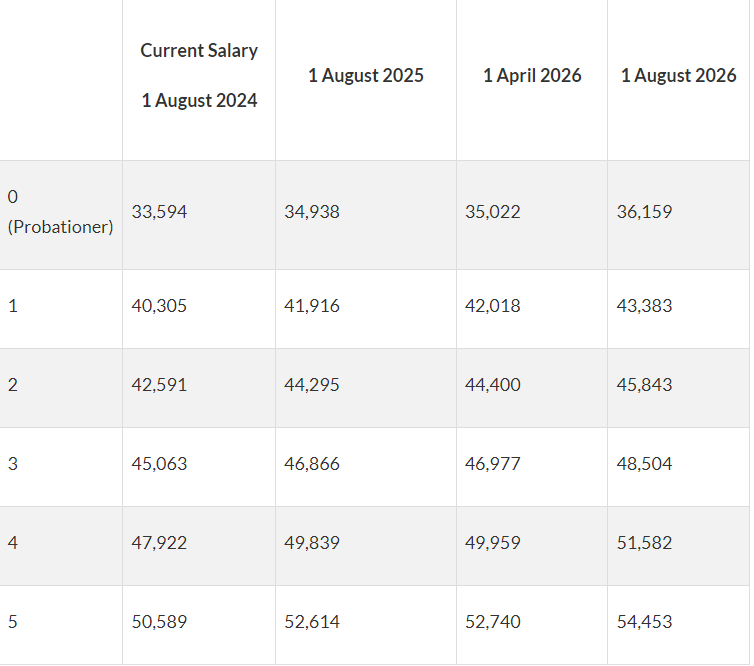
This is a fair point. I might be controversial here, but I do think teachers make a decent wage. That might just be because of my background, and I make a lot less money now that I’m not teaching. Teachers are also paid better in Scotland than they are in England. But I would be curious to know what other people think!
To be clear, I do think there is still an argument to be made that teachers are underpaid!
If you are interested here are the current salary bands
And just for fun, here are the current Scottish government salary bands
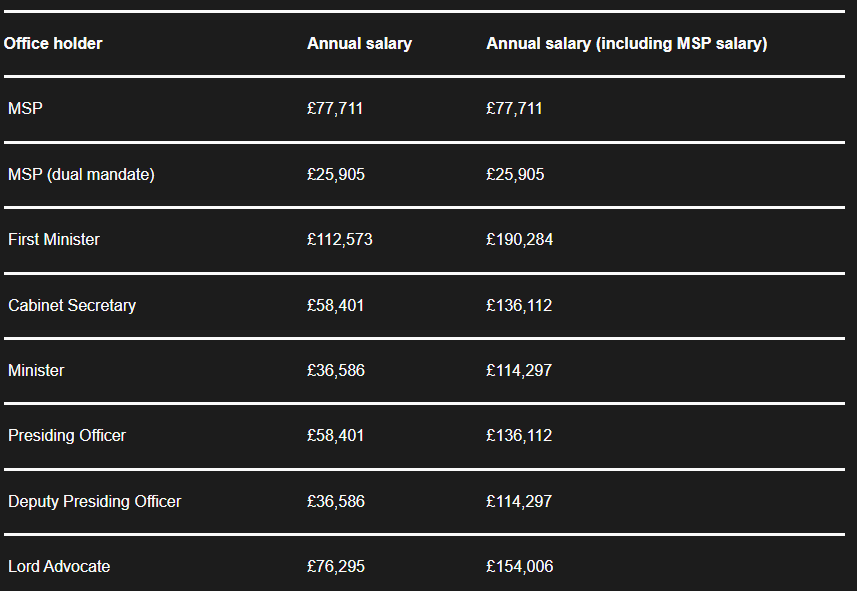
I am no expert in national budgets by any means, and I certainly would never want Jenny Gilruth’s job. I know that it is very complicated. But in 2024-25 local government education expenditure in Scotland was £8.3 billion. With a B. From my calculations, less that 10% of the budget is going to teachers.
I can’t help but think it’s surely worth the cost. You don’t have an education system without teachers. Plus, maybe if we trained fewer probationers, we could afford to give permanent contracts to more experienced teachers. I’d also just like to reiterate how many hours teachers work and what they have to deal with on a daily basis.
I’d like to know the last time Jenny Gilruth or John Swinney had a chair thrown at them.
(I recognise I may be going a bit hard on Jenny here. I have gone down a bit of a rabbit hole and found out she lives near me and she used to be a teacher! Crazy. And if for some insane reason you happen to be reading this, it’s not personal, Jenny. I’m just frustrated at the system... and it’s kinda your job to fix it.)
What can be done?
If I were in charge (And if I were honest, I’d do a complete overhaul of mainstream education and fundamentally change the entire system. It’s so broken and benefiting very few children, but that’s for another day). I would create more teaching jobs by making class sizes smaller and increasing the number of classes in schools. This would be better for teachers and better for students. However, that would cost a considerable amount of money, and I do get that it just wouldn’t be practical.
We could stop training as many teachers. At this point, we’re training them to send elsewhere anyway. That would mean less probationer posts and it would open up more jobs for more experienced teachers. This would not be pulling up the ladders of opportunity but stopping the construction of yet more bridges to nowhere.
Or at the very least, I feel we need to give students an informed choice about pursuing an education degree and what their realistic job prospects will be at the end of it.
Furthermore, there needs to be more permanent contracts given out. These teachers need job security. And children need consistency.
Finally, the government need to admit this is a problem and take do something about it. And to be fair to my old pal and neighbour, Jenny, she has done that. She accepted the current situation was "not good enough" and said the government and local authorities had to work together to fix it. There has been the issue that local authorities had been given money to employ extra teachers, a "large number" of councils had not used the money for that purpose.
If you are reading this and you want to go into teaching in Scotland, my honest advice is to reconsider. At least for now. It is an amazing job. It is a rewarding job. But it is also a hard job and an oversaturated market right now.
(Unless you want to be a secondary maths teacher then go ahead!)
Further Reading
This recent BBC Article is where I got a lot of the quotes I used! I’m so glad this issue is getting some mainstream attention! Teachers on supply list for years or leaving country due to job shortages
This is also the link for the tiktok page of- Teachers for Permanence. They have been doing a lot to raise awareness of this issue.
I also do not claim to speak for every teacher in Scotland. I am no longer a teacher. I just wanted to share my experiences and the little bit of research I’ve done!
If you’re a teacher or you know teachers, I’d really like to know if you are experiencing some of the things I’ve covered today.
BTW I know this was a long one and a niche topic! If you have got to this point thank you so much for reading! It really means a lot!